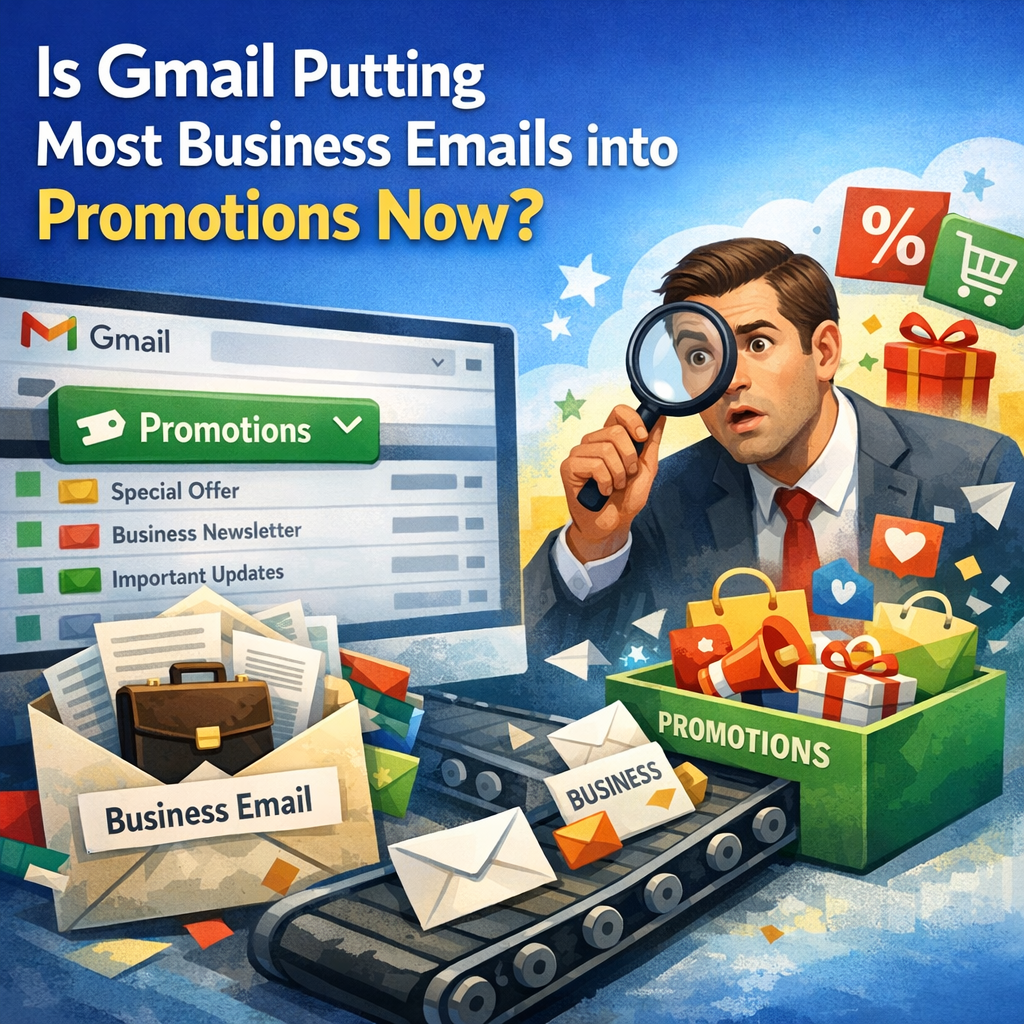
The Quiet Shift in Gmail’s Promotions Tab
Something odd has been happening in the world of B2B email—and if you’ve noticed your carefully written, plain-text messages quietly landing in Gmail’s Promotions tab instead of the Primary inbox, you’re not alone. Even when everything looks “right”—clean domains, proper authentication, warmed accounts, no links or images—emails still get filtered. It feels counterintuitive, especially when you’re sending thoughtful, one-to-one messages rather than blasting campaigns.
This article explores what’s really going on behind Gmail’s sorting behavior, why even legitimate business emails are increasingly categorized as promotional, and whether this shift is becoming the new normal. We’ll look at patterns observed across platforms like Instantly, Lemlist, and Saleshandy, unpack how Gmail likely interprets intent, and share grounded insights from real-world B2B experiences.
If you’ve been questioning whether you’re doing something wrong—or whether the rules have simply changed—you’re in the right place.
How Gmail Interprets Intent, Not Just Setup
Understanding Gmail’s Tab System: More Behavioral Than Technical
Gmail’s tab system—Primary, Promotions, Social, and Updates—was designed to improve user experience, not necessarily to judge the “quality” of your email. That distinction matters. The sorting algorithm doesn’t just look at technical setup (like SPF, DKIM, or DMARC), but heavily weighs behavioral and contextual signals.
Even a plain-text email with no links can be flagged as “promotional” if it resembles patterns Gmail associates with outreach or marketing. These patterns include subtle signals such as:
- Similar phrasing across multiple emails
- Repeated sending behavior across recipients
- Lack of prior conversation history
- Language that resembles a pitch or introduction
In other words, Gmail is less concerned with how “clean” your email is and more concerned with what it appears to be trying to do.
A useful way to think about it: Gmail is categorizing intent, not just format.
For example, two identical emails could land in different tabs depending on sender history and recipient interaction. A message from a colleague you've emailed before is likely to hit Primary, while the same message from a new sender may go to Promotions—even if it's highly personalized.
(A diagram here showing “Technical Signals vs Behavioral Signals” would help clarify this distinction.)
Why Plain Text No Longer Guarantees Placement
Why Plain Text Isn’t a Guaranteed Pass Anymore
There was a time when removing links, images, and formatting was enough to improve inbox placement. That strategy is now far less reliable.
Many B2B operators report the same experience: fully plain-text emails, manually reviewed and personalized, still ending up in Promotions. This suggests Gmail has evolved beyond surface-level signals.
What’s changed is scale detection. Gmail can now identify when emails—no matter how “personal” they look—are part of a broader pattern. If you're sending similar messages to multiple recipients within a timeframe, even through different tools, Gmail may group them into a promotional category.
It’s not necessarily penalizing you—it’s organizing content based on perceived user relevance.
Real-world observation from operators using tools like Lemlist or Instantly shows a consistent trend: once volume increases past a certain threshold, Primary placement drops, regardless of email simplicity.
This doesn’t mean personalization is ineffective—it just means it’s no longer enough on its own to influence tab placement.
The Changing Nature of the Primary Inbox
Is the Primary Inbox Becoming Harder to Reach?
Short answer: yes, but not in the way most people think.
The Primary tab is increasingly reserved for emails that reflect existing relationships or highly individualized communication. Think ongoing threads, replies, or contacts with prior engagement.
Cold or first-touch emails—even well-researched ones—often lack those signals. As a result, Gmail tends to categorize them as “promotional” simply because they resemble outreach rather than conversation.
This aligns with a broader shift in email usage. Gmail’s algorithm is adapting to protect users from overload, especially as outreach tools have scaled dramatically over the past few years.
Interestingly, many B2B operators report that even replies can “pull” future emails into Primary. That suggests engagement history plays a stronger role than initial email quality.
(A simple flowchart showing “First Contact → Engagement → Tab Shift” would work well here.)
So it’s not that Primary is unreachable—it’s that it’s increasingly reserved for interaction, not introduction.
A Platform-Wide Pattern Across B2B Senders
A Shared Experience Across B2B Senders
If this feels like a recent shift, that’s because it is. Across different industries and tools, a growing number of B2B senders report similar patterns:
- Promotions tab placement is now the default for cold outreach
- Plain text no longer guarantees Primary placement
- Authentication and domain health have less influence on tab categorization than expected
- Engagement (opens, replies) appears to influence future placement more than initial setup
What’s notable is the consistency. Whether someone is using Saleshandy, Instantly, or sending manually through Gmail, the outcome is often the same.
This suggests the behavior is not tool-specific—it’s platform-level.
There’s also anecdotal evidence that Gmail is clustering emails at the campaign level, even when senders attempt to randomize content. That makes it harder to “blend in” as purely one-to-one communication at scale.
In practical terms, this means many legitimate business emails are now being treated similarly to marketing content—not because they are spam, but because they share structural similarities with outreach campaigns.
What Matters Now: Engagement Over Placement
Tips and Practical Observations from the Field
While this article isn’t about tactics, there are a few grounded takeaways based on what operators are observing in real environments.
First, expectations need to shift. Landing in Promotions is not necessarily a failure. Many users actively check that tab, especially in business contexts. The real metric to watch is response rate, not tab placement.
Second, engagement matters more than ever. Emails that receive replies tend to improve future placement, suggesting Gmail uses interaction as a trust signal.
Third, volume and pattern consistency appear to influence categorization. Even small campaigns can trigger Promotions placement if they follow recognizable structures.
Fourth, there’s increasing evidence that Gmail evaluates sender-recipient relationships over time. A cold email may land in Promotions, but continued interaction can shift future messages into Primary.
(A table comparing “Common Assumptions vs Observed Reality” could be useful here for clarity.)
Finally, it’s worth noting that different recipients may see your emails in different tabs. Gmail personalizes inbox organization per user, so there is no single universal outcome.
The movement of B2B emails into Gmail’s Promotions tab isn’t a glitch or a sign that something is broken—it’s a reflection of how email ecosystems are evolving. Gmail is becoming more sophisticated in interpreting intent, prioritizing user experience over sender expectations.
For B2B operators, this means adapting to a new reality where Primary inbox placement is less about technical perfection and more about relationship and engagement. Plain text, personalization, and clean setup still matter—but they no longer control the outcome the way they once did.
The key shift is conceptual: instead of asking “How do I reach Primary?” it may be more useful to ask “How do recipients engage with my message, regardless of where it lands?”
Because ultimately, inbox tabs don’t reply—people do.
References and Further Reading
- Google Workspace Updates Blog (for insights into Gmail feature changes)
- SparkToro and other marketing research blogs discussing email deliverability trends
- Email Geeks community discussions (informal but experience-rich insights)
- Reports from tools like Mailgun or Postmark on deliverability benchmarks
Exploring these sources can provide additional context on how inbox algorithms are evolving—and why your experience is increasingly common across the B2B landscape.