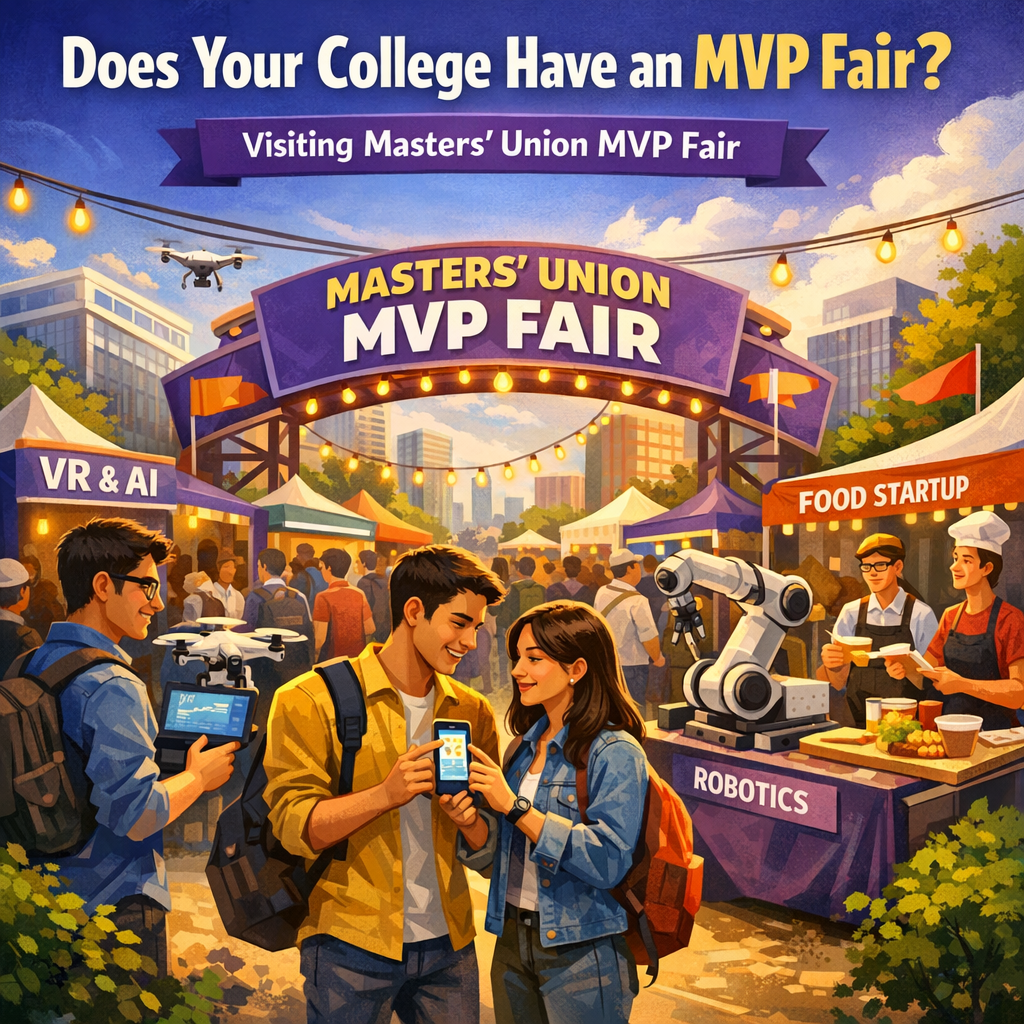
A Shift from Presentation to Progress
What if college events stopped rewarding polished slides and started rewarding real progress? That’s exactly what happened at a recent MVP (Minimum Viable Product) fair at my college. No PowerPoints, no rehearsed speeches—just students standing beside products they’re actually building, explaining what works, what doesn’t, and what comes next. It felt less like an academic exercise and more like stepping into a startup incubator.
This article explores why that shift matters, how MVP fairs work, and why more colleges should adopt this model. You’ll also learn how such events can reshape student learning, along with practical ways institutions and students can bring similar initiatives to life.
Traditional college showcases often prioritize presentation skills over product reality. Students spend weeks perfecting slides, animations, and scripts—sometimes at the expense of actually building something meaningful. While communication is important, it can overshadow the core purpose of innovation: solving real problems.
The MVP fair flipped this dynamic entirely. Students showcased early versions of their products—apps, platforms, prototypes, and services—without relying on slides. Instead of saying “this is what I plan to build,” they demonstrated “this is what I’ve already built.” That small shift created a big difference.
For example, one student team presented a budgeting app designed for college students. Instead of mockups, they had a working prototype with real users already testing it. Another group showcased a campus delivery service they had already piloted over a few weekends. These weren’t hypothetical ideas—they were living experiments.
[Suggested visual: A photo of students demonstrating their MVPs in a booth-style setup, interacting with visitors.]
What Defines an MVP Fair Experience
An MVP fair is grounded in a simple principle: progress over perfection. The goal is not to impress with polish, but to demonstrate traction, learning, and iteration.
Unlike traditional events, MVP fairs emphasize:
• Real users: Students are encouraged to validate their ideas with actual users before presenting.
• Working prototypes: Even a basic version is better than a perfect concept.
• Honest feedback: Conversations revolve around what’s working and what needs improvement.
• Iteration: Projects are seen as evolving, not finished products.
This approach mirrors real-world startup environments. In fact, many successful companies began as rough MVPs. Instagram started as a simple photo-sharing app with limited features. Airbnb began with a basic website and a few rented air mattresses. The MVP mindset encourages launching early, learning fast, and improving continuously.
[Suggested visual: A comparison infographic showing “Traditional Presentation vs MVP Fair” highlighting differences in focus, format, and outcomes.]
How MVP Fairs Transform Student Learning
The educational value of an MVP fair goes beyond technical skills. It reshapes how students think about problem-solving, risk, and creativity.
First, it builds a bias toward action. Students stop waiting for the “perfect idea” and start experimenting. This reduces fear of failure because the emphasis shifts from getting it right to learning quickly.
Second, it strengthens critical thinking. When students interact with real users, they encounter unexpected challenges. This forces them to adapt, refine their assumptions, and make better decisions.
Third, it improves communication in a more authentic way. Explaining a real product to peers, mentors, or judges requires clarity and honesty. There’s no hiding behind slides—students must truly understand what they’ve built.
A case study from institutions that emphasize experiential learning shows that students engaged in project-based environments are more likely to retain knowledge and develop entrepreneurial skills. According to research by the National Survey of Student Engagement (NSSE), hands-on learning significantly improves student engagement and career readiness.
[Suggested visual: A chart showing increased student engagement or skill development in experiential learning environments.]
Building and Implementing an MVP Fair
Bringing an MVP fair to life doesn’t require massive resources. It requires a shift in mindset and a clear structure.
Step one: Set clear expectations. Students should understand that they need to present something functional, even if it’s incomplete. Encourage them to focus on solving a real problem.
Step two: Provide a timeline. Give students a few weeks or months to build their MVPs. Include checkpoints where they can receive feedback and refine their ideas.
Step three: Create a demo-friendly environment. Instead of a stage, set up booths or stations where students can interact with visitors. This makes the experience more dynamic and engaging.
Step four: Invite diverse evaluators. Include faculty, industry professionals, entrepreneurs, and even potential users. Their perspectives will provide richer feedback.
Step five: Focus on feedback, not just judging. While awards can be motivating, the primary goal should be learning. Encourage evaluators to ask questions and suggest improvements.
[Suggested visual: A flow diagram showing the MVP fair process from idea to demo day.]
Challenges, Opportunities, and a Call to Build
Despite its benefits, MVP-based learning is not yet widespread. There are a few reasons for this.
Many institutions are still rooted in traditional evaluation systems that prioritize theoretical knowledge and structured presentations. Shifting to a more experimental model can feel risky, both for educators and administrators.
There’s also the challenge of resources and mentorship. Students building real products often need guidance, tools, and sometimes funding. Not all colleges are equipped to provide this support.
However, these barriers are not insurmountable. Even small-scale MVP fairs can create meaningful impact. A classroom-level initiative can be just as powerful as a campus-wide event.
The bigger question is not whether colleges can adopt this model, but whether they can afford not to. In a world that increasingly values innovation and adaptability, students need opportunities to practice building, not just presenting.
If you’re a student, start small. You don’t need a perfect idea—just a problem worth exploring. Build a simple version, test it with a few users, and learn from the experience. Focus on progress, not perfection.
If you’re an educator, create space for experimentation. Encourage students to take risks and learn from failure. Even replacing one traditional presentation with an MVP demo can make a difference.
For institutions, consider piloting an MVP fair with a small group of students. Gather feedback, refine the format, and expand gradually. Collaboration with industry partners can also enhance the experience by providing mentorship and real-world insights.
[Suggested formatting: A short checklist or numbered list summarizing steps for students and educators could improve clarity here.]
The MVP fair was more than just an event—it was a glimpse into what education could become. By shifting the focus from polished presentations to real progress, it encouraged students to think, build, and learn in a way that feels relevant to the real world.
Colleges have an opportunity to redefine how students engage with ideas. Instead of asking, “Can you explain your concept?” they can ask, “Can you show what you’ve built?” That simple change can unlock creativity, confidence, and capability.
If your college doesn’t have something like this yet, maybe it’s time to start the conversation. Innovation doesn’t begin with slides—it begins with action.
References and Further Reading
• Eric Ries – “The Lean Startup” (for understanding MVP concepts)
• National Survey of Student Engagement (NSSE) reports on experiential learning
• Stanford d.school resources on design thinking and prototyping
• Y Combinator Startup School (free online resource for building MVPs)
• Harvard Business Review articles on innovation and rapid prototyping