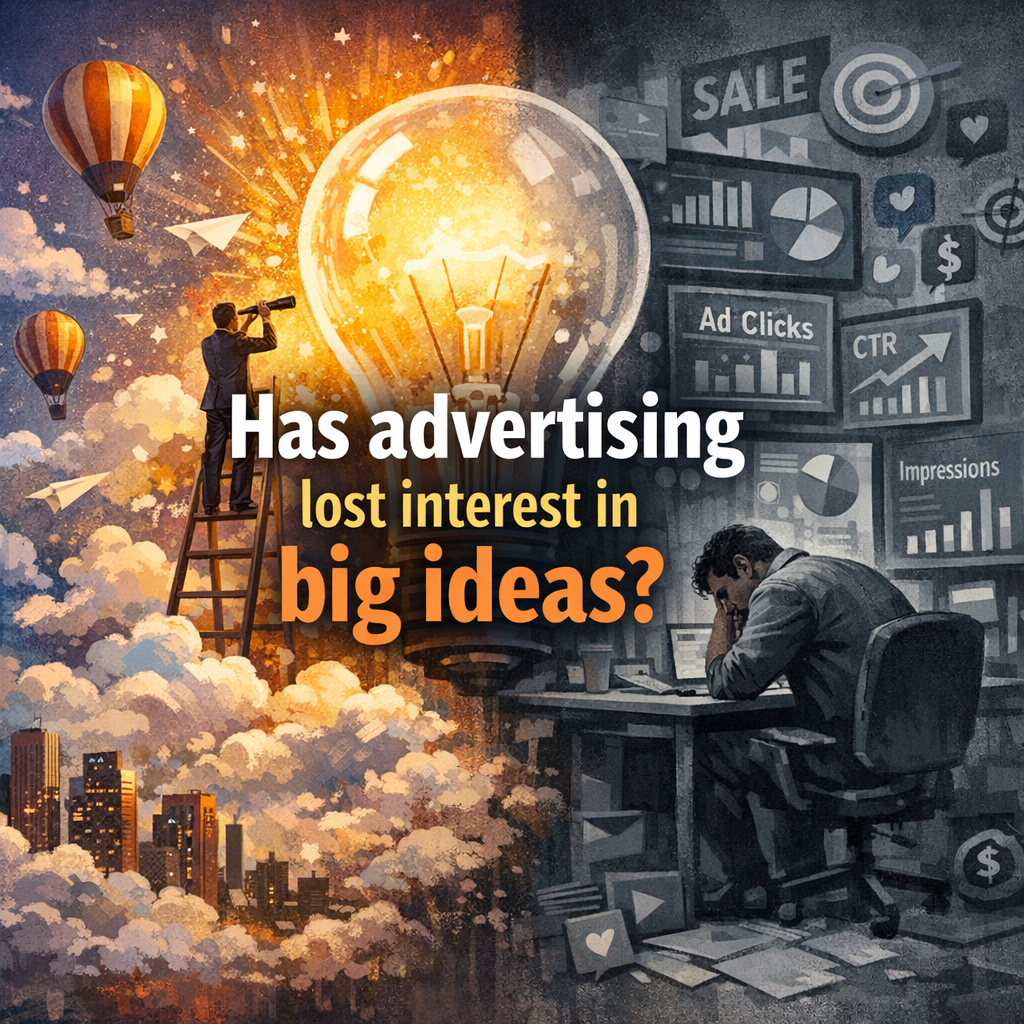
The tension between big ideas and daily realities
There’s a quiet tension running through many creative departments right now. On one hand, the industry still celebrates the mythology of “the big idea”—those bold, culture-shaping concepts that define brands for years. On the other, the day-to-day reality feels very different: tighter timelines, smaller budgets, and a constant demand for measurable results. For many mid-level creatives, this gap isn’t just frustrating—it’s confusing.
If you’ve ever felt like promising conceptual directions get shut down in favor of safer, shinier, but ultimately hollow ideas, you’re not alone. This article explores why that’s happening, what’s changed in the industry, and how creatives can adapt without losing their appetite for meaningful ideas.
By the end, you’ll have a clearer understanding of the forces shaping creative decisions today—and some practical ways to navigate them.
From big campaigns to constant content
The shifting role of the “big idea”
Traditionally, advertising revolved around a central, unifying concept—the big idea. Think of campaigns like “Think Different” or “Just Do It.” These weren’t just taglines; they were platforms that guided years of storytelling.
Today, that model is under pressure. Brands are increasingly investing in high volumes of content rather than singular, high-impact campaigns. Social media, programmatic advertising, and always-on marketing have changed the output from “a few big swings” to “constant activity.”
This shift has real consequences. When teams are tasked with producing dozens—or hundreds—of assets quickly, the emphasis naturally moves from depth to speed. Ideas don’t always get the time or space to evolve. Instead of asking “What’s the most interesting direction here?”, the question becomes “What can we ship by tomorrow?”
An infographic here could effectively illustrate the evolution from traditional campaign models to modern content ecosystems.
Why decision-makers play it safe
Why Creative Directors may seem risk-averse
It’s easy to interpret quick dismissals of conceptual ideas as a lack of curiosity or creative ambition. But in many cases, the reality is more structural than personal.
Creative Directors today operate under intense pressure from multiple directions: clients demanding fast turnaround, account teams focused on delivery, and performance metrics that are tracked in real time. In this environment, exploring an unproven idea isn’t just creatively risky—it’s commercially risky.
Consider the economics. A big idea often requires investment: production budgets, time for development, and internal buy-in. If there’s no clear, immediate return, it becomes harder to justify. As one industry perspective puts it, brands would rather fund a high volume of lower-cost assets that can be tested, optimized, and iterated quickly.
This doesn’t mean Creative Directors don’t value ideas. It means they’re often balancing creative ambition against operational reality. What can look like a lack of interest in conceptual thinking is sometimes a response to constraints that aren’t always visible at the team level.
A simple chart comparing “idea-driven campaigns” versus “performance-driven content” could help clarify this tension.
The rise of performance marketing and its impact
One of the biggest drivers behind this shift is the rise of performance marketing. With advanced analytics, brands can now measure success almost instantly—click-through rates, conversions, return on ad spend, and more.
This has fundamentally changed how creative work is evaluated. Instead of being judged on originality or long-term brand impact, work is increasingly assessed on short-term results.
In this context, even a visually bland or conceptually simple ad can “win” if it performs well. That creates a feedback loop: safe, proven formats get repeated, while more experimental ideas struggle to get traction.
For creatives, this can feel like a narrowing of the field. Big ideas often require time to resonate and don’t always deliver immediate returns. When success is defined by instant metrics, the environment becomes less forgiving of exploration.
A case study section here could compare a high-performing but simple ad versus a creatively ambitious campaign with slower returns.
The evolution of the big idea
Are big ideas actually disappearing—or just evolving?
Despite the challenges, it would be inaccurate to say that big ideas are gone entirely. They’re evolving.
In many cases, the “big idea” now needs to function differently. Instead of anchoring a single campaign, it must be flexible enough to generate ongoing content across platforms. It has to work in a six-second video, a social post, and a full-length brand film.
This shift requires a different kind of thinking. The best ideas today aren’t just bold—they’re scalable. They can stretch across formats while still maintaining a core concept.
There’s also a growing trend toward prototyping ideas before pitching them. Some creatives are using AI tools and rapid production techniques to create high-fidelity mockups—turning abstract concepts into tangible outputs. This reduces perceived risk and helps stakeholders “see” the idea rather than imagine it.
In a way, the big idea isn’t dying—it’s being forced to prove itself faster and more concretely than before.
Navigating constraints while keeping ideas strong
Practical ways to navigate this landscape
If you’re feeling stuck between wanting to push for stronger ideas and needing to operate within current constraints, there are ways to bridge that gap.
First, make your ideas easier to buy. The more tangible your concept feels, the harder it is to dismiss. This might mean creating rough visuals, mock ads, or even short video prototypes.
Second, connect creativity to outcomes. While it’s frustrating, aligning your idea with business goals increases its chances of survival. Show how your concept can perform, not just how it looks or feels.
Third, think in systems, not just executions. Instead of pitching a single “hero” idea, demonstrate how it can generate multiple pieces of content. This aligns your thinking with how brands operate today.
Fourth, pick your moments. Not every brief is an opportunity for a big conceptual leap. Recognizing when to push—and when to deliver quickly—can help you build credibility and earn more freedom over time.
A step-by-step diagram here could outline the journey from initial concept to approved idea, highlighting where prototypes and performance framing can help.
Tips and actionable advice
When developing ideas in today’s environment, focus on clarity and adaptability. A strong concept should be easy to explain in one sentence and flexible enough to live across multiple formats.
Consider building a habit of “idea visualization.” Even a rough storyboard or AI-generated mock can dramatically improve how your work is received.
Stay informed about performance metrics, even if they’re not your primary focus. Understanding how your work is evaluated helps you position it more effectively.
Finally, seek out collaborators who still value conceptual thinking. The right Creative Director or team can make a significant difference in how ideas are nurtured.
A bullet-point checklist could be added here to summarize these tips for quick reference.
Conclusion
The frustration many creatives feel today is real—but it’s not simply a matter of declining standards or disinterested leadership. The industry has shifted in response to new technologies, new metrics, and new client expectations.
Big ideas haven’t disappeared—they’re being reshaped by a faster, more data-driven world. The challenge for creatives is to adapt without losing the essence of what makes ideas powerful in the first place.
If anything, this moment calls for a new kind of creative thinking: ideas that are not only bold, but also agile, demonstrable, and aligned with how modern marketing works.
References and further reading
For deeper exploration, consider reading materials on the evolution of performance marketing, such as reports from McKinsey on digital transformation in advertising, or insights from WARC on effectiveness versus efficiency in campaigns.
Books like “How Brands Grow” by Byron Sharp provide context on brand-building versus short-term activation, while platforms like Campaign and Adweek regularly publish case studies on modern creative strategies.
Exploring these perspectives can help you better understand the forces shaping your work—and find smarter ways to navigate them.