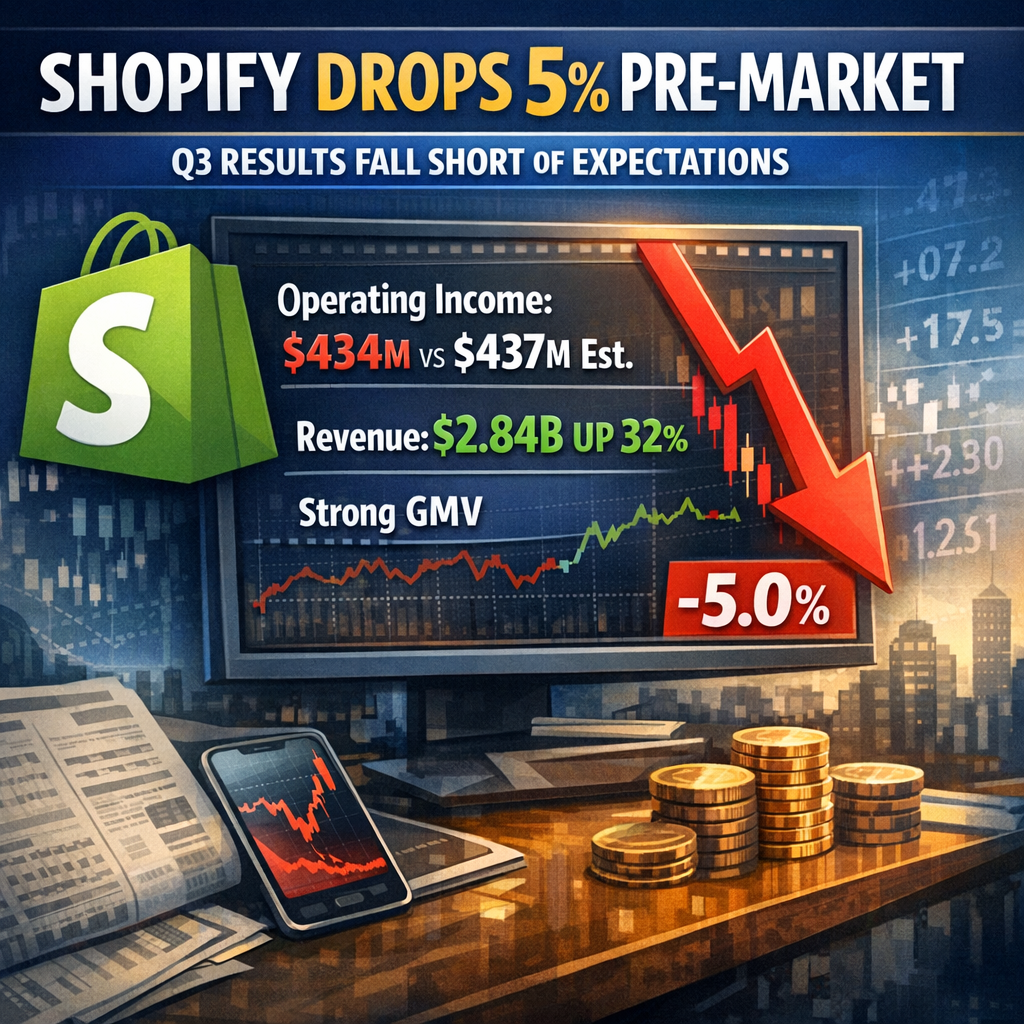
The Paradox of Strong Results and Falling Shares
Shopify’s latest earnings report delivered a classic market paradox: strong growth on the surface, yet a negative reaction from investors. Revenue beat expectations, operating income surged year over year, and the company continues expanding globally—so why did the stock fall?
This kind of reaction can feel confusing, especially for newer investors. But it highlights an important truth about the stock market: performance isn’t just about what a company achieves—it’s about how those results compare to expectations and valuations. In this article, we’ll break down Shopify’s latest earnings, explain what really drove the stock’s decline, and help you understand the bigger picture behind growth stocks like Shopify.
By the end, you’ll have a clearer grasp of earnings reports, valuation metrics, and how to interpret market reactions more effectively.
A Closer Look at Shopify’s Q3 Performance
At first glance, Shopify’s third-quarter results looked impressive. The company reported revenue of $2.844 billion, a 32% increase year over year and above analyst expectations of $2.757 billion. That’s a strong signal that demand for Shopify’s e-commerce platform remains robust, especially as businesses continue shifting online.
Operating income also rose significantly—up 53% to $434 million. However, this is where things get interesting: analysts had expected $437 million. The difference is small, but in the world of high-growth stocks, even slight misses can trigger outsized reactions.
Shopify also provided guidance for the upcoming December quarter that roughly matched expectations. Normally, that would be reassuring. But when a stock carries a premium valuation, “meeting expectations” isn’t always enough to keep investors satisfied.
(Suggested visual: A simple chart comparing expected vs. actual revenue and operating income.)
Expectations, Valuation, and Market Reactions
The market’s reaction to Shopify’s earnings highlights a key concept: stocks move based on expectations, not just results. Shopify is widely seen as a high-growth company, and its stock price reflects that optimism.
When investors buy into a company like Shopify, they’re not just paying for current performance—they’re betting on future growth. That’s why even a small miss on operating income can trigger a sell-off. It raises subtle concerns about margins, scalability, or future profitability.
Another factor is valuation. Some investors pointed out that Shopify trades at very high multiples, such as revenue multiples. This sparked debate online, with some confusion between revenue multiples (price-to-sales) and earnings multiples (price-to-earnings).
Here’s the distinction in simple terms:
- A revenue multiple compares a company’s market value to its sales.
- An earnings multiple compares market value to profits.
For high-growth companies like Shopify, revenue multiples are often emphasized because profits can be inconsistent or reinvested into growth. But high multiples—whether based on revenue or earnings—mean expectations are elevated. That leaves little room for disappointment.
(Suggested visual: A comparison infographic showing price-to-sales vs. price-to-earnings ratios.)
Expansion Strategy and Long-Term Growth Drivers
Beyond the numbers, Shopify’s long-term strategy is crucial to understanding its trajectory. The company is actively expanding into enterprise-level clients and international markets, both of which represent major growth opportunities.
Traditionally, Shopify has been known for serving small and medium-sized businesses. However, moving upmarket to larger enterprises can significantly increase revenue per customer. Enterprise clients tend to require more complex solutions, but they also bring higher and more stable income.
International expansion is another key driver. As e-commerce adoption grows globally, Shopify is positioning itself as a platform that can support merchants across different regions, currencies, and regulatory environments.
This strategy helps explain why investors still view Shopify as a long-term growth story—even if short-term earnings occasionally disappoint.
(Suggested visual: A world map highlighting Shopify’s international expansion or a diagram of its enterprise vs. SMB customer segments.)
Making Sense of Earnings and Investor Takeaways
If Shopify’s earnings reaction seems confusing, you’re not alone. Many investors focus only on whether a company “beats” or “misses” expectations. But there’s more nuance involved.
Here’s a simple step-by-step approach you can use when analyzing earnings reports:
First, compare actual results to expectations. Look at revenue, earnings, and key metrics relative to analyst forecasts.
Second, examine growth rates. Even if a company misses expectations slightly, strong year-over-year growth can still indicate a healthy business.
Third, review guidance. Future expectations often matter more than past performance. A company that lowers its outlook may see its stock drop—even after strong results.
Fourth, consider valuation. High-growth companies with premium valuations are more sensitive to small disappointments.
Finally, look at the bigger picture. Consider strategy, competitive position, and long-term trends rather than focusing only on quarterly fluctuations.
(Suggested visual: A checklist-style infographic for analyzing earnings reports.)
Shopify’s earnings provide several useful lessons for investors trying to navigate growth stocks.
One key takeaway is to avoid focusing solely on headline numbers. A revenue beat doesn’t guarantee a stock will rise, just as a small earnings miss doesn’t mean a company is struggling.
It’s also important to understand valuation. When a stock trades at high multiples, expectations are already priced in. That means the margin for error is small, and volatility is more likely.
Another practical tip is to separate short-term noise from long-term trends. Shopify’s expansion into enterprise and international markets may take time to fully reflect in financial results, but these moves could be more important than any single quarter.
Finally, be cautious when interpreting online discussions. As seen in the Reddit exchange, confusion between revenue and earnings multiples can lead to misleading conclusions. Make sure you understand the metrics being used before forming an opinion.
Shopify’s latest earnings report is a great example of how the stock market works in practice. Strong growth, rising revenue, and expanding strategy weren’t enough to lift the stock—because expectations were already high.
This doesn’t necessarily signal weakness in the business. Instead, it reflects the delicate balance between performance and valuation. For investors, the key lesson is to look beyond surface-level results and understand the broader context.
As Shopify continues to grow and evolve, its long-term success will depend not just on delivering strong numbers, but on exceeding the high expectations baked into its stock price.
References and Further Reading
- Investor’s Business Daily: Shopify Q3 2025 earnings coverage
- Investopedia: Understanding price-to-sales and price-to-earnings ratios
- Shopify Investor Relations: Official earnings reports and shareholder letters
- Aswath Damodaran (NYU): Valuation frameworks for high-growth companies
For deeper insight, consider reviewing multiple earnings reports over time to see how Shopify’s growth strategy translates into financial performance.