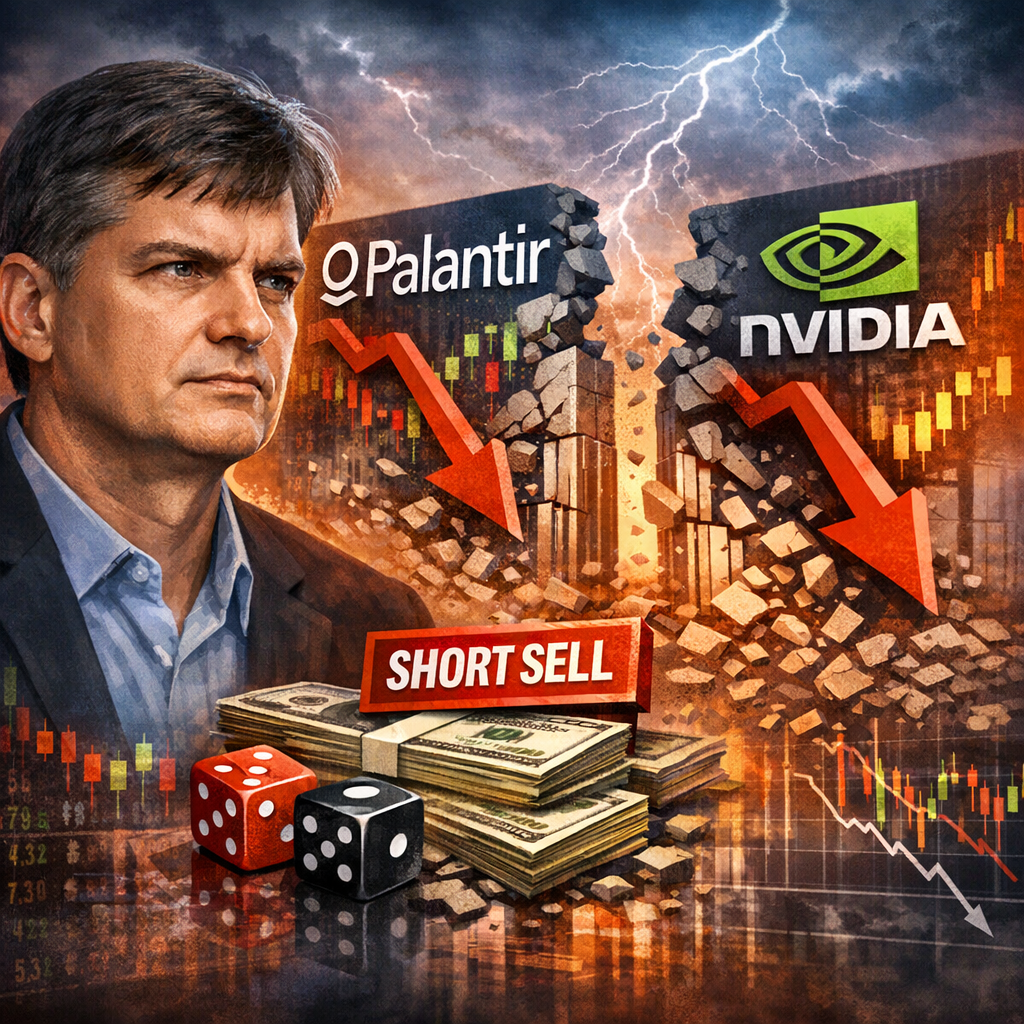
Burry’s Latest Move and What It Signals
When Michael Burry makes a move, markets tend to pay attention. After all, this is the investor who famously predicted—and profited from—the 2008 housing collapse. Now, he’s back in the spotlight with a bold new set of trades targeting two of the hottest names in the market: Nvidia and Palantir. Both companies have ridden the explosive wave of artificial intelligence enthusiasm, but Burry appears to be betting that the hype may have gone too far.
In this article, we’ll unpack what Burry’s latest positions actually mean, explore the broader AI-driven market rally, and separate signal from noise when it comes to interpreting “big short” narratives. By the end, you’ll have a clearer understanding of whether this is a looming bubble—or simply smart risk management.
Understanding the Mechanics Behind the Trade
Headlines often simplify complex financial strategies, and this situation is no exception. Reports suggest that Burry’s hedge fund, Scion Asset Management, purchased put options against Nvidia (NVDA) and Palantir (PLTR). At face value, that sounds like a direct bet that these stocks will fall. But the reality is more nuanced.
Put options give the holder the right (but not the obligation) to sell a stock at a predetermined price. Investors use them in two main ways: speculation and hedging. In Burry’s case, the size and structure of the positions suggest they may function more like insurance policies than outright bearish bets.
For example, filings indicate exposure equivalent to millions of shares—roughly $912 million in notional value for Palantir and $187 million for Nvidia. However, “notional value” does not equal the amount of money actually invested. The true cost is the premium paid for those options, which is typically far smaller.
This distinction matters. A hedge fund managing around $150 million in assets is unlikely to take on massive directional bets that exceed its capital base. Instead, these options may be designed to offset potential losses elsewhere in the portfolio, allowing participation in the market while limiting downside risk.
[Suggested visual: A simple infographic explaining how put options work vs. owning stock]
The AI Boom Driving Market Enthusiasm
To understand why Burry might be cautious, you have to look at the broader context. Nvidia and Palantir have been among the biggest beneficiaries of the AI boom.
Nvidia, a leader in GPU technology, has become the backbone of AI infrastructure. Its chips power everything from large language models to data centers, driving explosive revenue growth and pushing its valuation to historic highs.
Palantir, meanwhile, has positioned itself as a key player in AI-driven data analytics, especially for governments and large enterprises. Its narrative has shifted from a niche data company to a central figure in the AI revolution.
This surge has been fueled not just by earnings growth, but by investor enthusiasm. When markets latch onto a transformative theme—like AI—valuations can stretch far beyond traditional metrics.
Historically, similar patterns have emerged during major technological shifts:
• The dot-com bubble of the late 1990s
• The clean energy surge in the early 2020s
• Cryptocurrency booms across multiple cycles
In each case, strong long-term potential coexisted with short-term overvaluation risks.
[Suggested visual: A chart comparing Nvidia’s stock price growth with revenue growth over time]
Bubble Fears Versus Strategic Risk Management
One of the biggest misconceptions in financial media is equating hedging with outright bearish conviction. Burry’s move has been widely framed as “calling the top,” but that interpretation may be overly simplistic.
Professional investors often hedge even when they remain broadly bullish. Why? Because markets can be unpredictable, and protecting against downside risk is a core part of long-term success.
Think of it this way: buying put options is like purchasing insurance on your house. You don’t necessarily expect it to burn down—but you’re prepared if it does.
There’s also the issue of timing. Burry famously shorted the housing market years before it collapsed. Being right too early can be just as costly as being wrong. Markets can stay irrational longer than investors can stay solvent, especially for those without deep pockets.
This is why many analysts caution against interpreting his trades as a definitive signal that a crash is imminent. Instead, they may reflect a cautious stance in a market that has become increasingly concentrated in a handful of high-growth tech stocks.
[Suggested visual: Timeline of Burry’s 2008 trade vs. market collapse]
What Investors Can Learn and How to Respond
It’s tempting to follow high-profile investors, but blindly copying their strategies can be risky—especially when those strategies involve complex instruments like options.
Here’s a simple framework to interpret moves like Burry’s:
First, consider scale. Institutional investors operate with different resources, risk tolerance, and time horizons. A strategy that works for a hedge fund may not translate well to an individual portfolio.
Second, understand the instrument. Options are not just directional bets—they involve time decay, volatility, and pricing complexities. Misusing them can lead to losses even if your market view is correct.
Third, separate narrative from data. Media headlines often amplify dramatic interpretations. Digging into filings and understanding the mechanics can reveal a more balanced picture.
Finally, focus on your own goals. Whether or not AI stocks are overvalued, your investment decisions should align with your risk tolerance and long-term plan—not short-term headlines.
If you’re investing during a period of intense market enthusiasm, a few practical strategies can help:
Maintain diversification. Avoid over-concentration in a single theme, even one as compelling as AI.
Use position sizing wisely. Limit how much of your portfolio is exposed to high-volatility assets.
Consider hedging alternatives. If options feel too complex, simple strategies like holding cash or bonds can reduce risk.
Stay disciplined with valuations. Even great companies can become poor investments if bought at extreme prices.
Be patient. Markets move in cycles, and opportunities often arise when sentiment cools.
[Suggested visual: Table comparing risk management strategies for retail investors]
Final Perspective on Signal Versus Noise
Michael Burry’s latest moves have reignited debate about whether the AI-driven market rally is sustainable. While his reputation lends weight to his actions, the reality is less dramatic than headlines suggest.
Rather than a clear-cut prediction of an impending crash, his positions may reflect cautious optimism—participating in the market while protecting against downside risk.
For investors, the key takeaway isn’t to mimic Burry, but to understand the broader lesson: even in booming markets, risk management matters. Whether AI proves to be a lasting revolution or a temporary bubble, those who balance opportunity with caution are more likely to navigate whatever comes next.
References and Further Reading
• Business Insider: Coverage of Michael Burry’s recent trades
• SEC 13F Filings (Scion Asset Management)
• Whalewisdom: Hedge fund portfolio tracking
• Books: “The Big Short” by Michael Lewis
• Investopedia: Guides on options trading and market bubbles