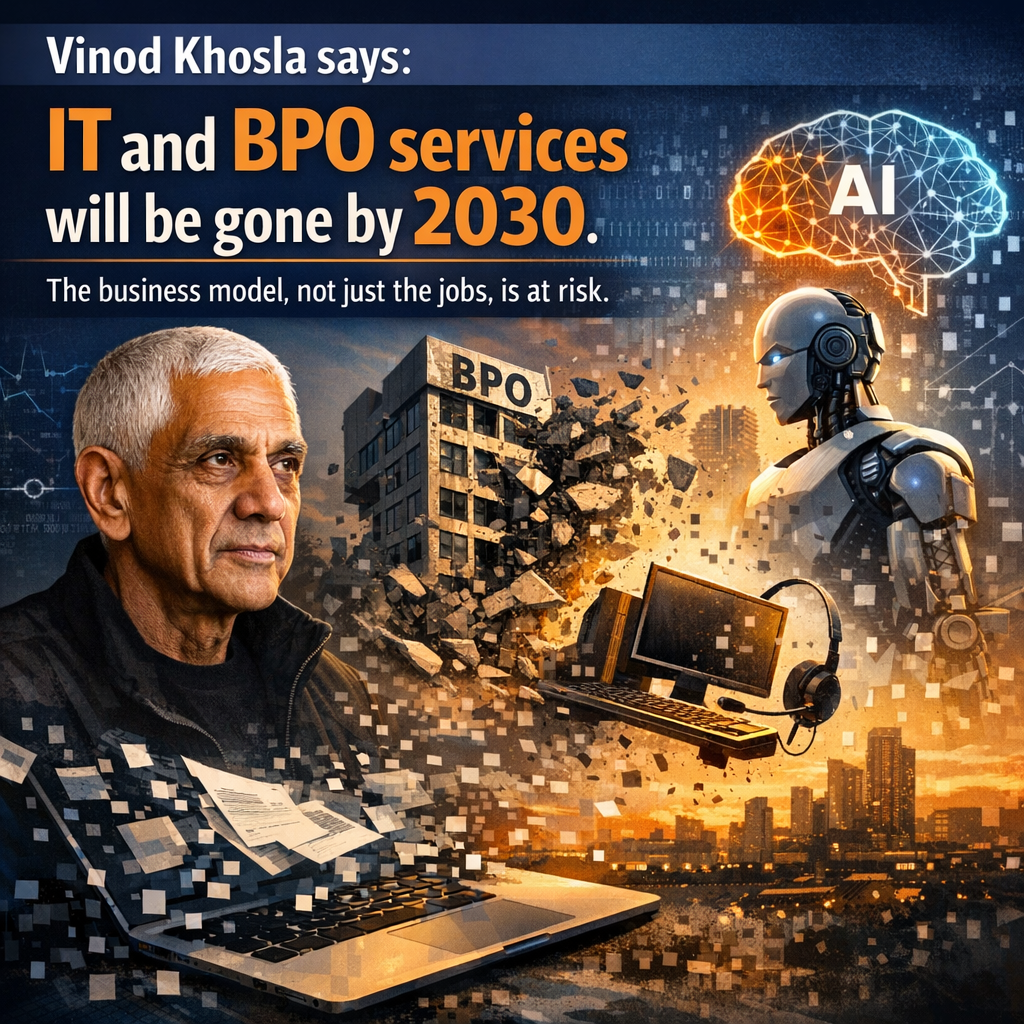
AI’s Direct Challenge to the Outsourcing Model
At a recent AI summit in India, venture capitalist Vinod Khosla made a bold prediction: the IT services and BPO (Business Process Outsourcing) industry could “almost certainly disappear within five years.” That’s not a claim about gradual layoffs or incremental efficiency gains—it’s a direct challenge to the very foundation of a multi-billion-dollar global business model.
If that sounds extreme, it’s worth unpacking the logic behind it. For decades, outsourcing has been driven by one simple equation: labor cost arbitrage. Companies in higher-cost countries outsource work to regions where skilled labor is cheaper. But what happens when labor itself is no longer the primary cost driver?
In this article, we’ll explore why AI is disrupting the outsourcing model, what’s already happening on the ground, the arguments for and against this “collapse” narrative, and how companies can adapt before the shift becomes irreversible.
Why Cost Arbitrage No Longer Holds
To understand the disruption, you have to understand what made outsourcing work in the first place. IT services giants like Infosys, Wipro, TCS, and Accenture built their empires by offering skilled human labor at lower costs than their clients could find locally.
This model worked because of three key factors:
First, global wage differences allowed companies to save significantly on operational costs.
Second, improvements in communication and infrastructure made remote work feasible at scale.
Third, standardized processes—like customer support, data entry, and application maintenance—made it easy to shift work across borders.
But AI fundamentally breaks this equation. An AI system doesn’t have a geographic cost structure. It doesn’t demand salaries, benefits, or office space. Once deployed, its cost per task trends downward over time.
In other words, the very reason outsourcing exists—cheaper human labor—is being replaced by something even cheaper and more scalable.
Early Disruption and Industry Response
This isn’t just theoretical. Early signs of disruption are already visible, particularly in BPO sectors like customer support.
In many organizations, the first layer of customer interaction—chat, email, and even voice—is increasingly handled by AI systems. Human agents now step in only for complex or escalated issues.
In some reported cases, thousands of frontline roles have already been reduced across multiple BPO providers. E-commerce companies, in particular, are aggressively adopting AI to handle high-volume, repetitive queries.
However, the impact is uneven. Telecom companies, for example, have long used automated systems like IVR (interactive voice response), and customer behavior still leans heavily toward human interaction—especially for complaints. This slows down full automation.
Meanwhile, larger BPO firms are not standing still. Instead of resisting AI, they are integrating it into their offerings. They’re repositioning themselves as AI-enabled service providers, bundling automation tools with human oversight.
This shift is crucial. It suggests that while smaller, less adaptable firms may struggle to survive, larger players could evolve rather than disappear.
[Suggested visual: A flow diagram showing traditional BPO workflow vs AI-augmented workflow]
Will Efficiency Expand Demand Instead?
Not everyone agrees with Khosla’s prediction. A strong counterargument comes from economic history, particularly a concept known as Jevons Paradox.
This principle suggests that when a resource becomes more efficient and cheaper to use, demand for it often increases rather than decreases.
A classic example is the rise of the internet. When publishing content became dramatically cheaper and easier, it didn’t eliminate jobs—it created entirely new industries and dramatically expanded demand for digital services.
Applied to AI, the argument goes like this: if software development, customer support, and IT operations become 10 times cheaper, companies won’t necessarily spend less—they may simply do more.
This could lead to:
More software being built
More experimentation and innovation
Greater demand for customization and integration
In this scenario, the bottleneck shifts from execution to strategy, creativity, and oversight. The nature of work changes, but the total volume of work may actually increase.
So instead of eliminating the IT services industry, AI could expand it—just in a very different form.
A Shift Toward New Business Models
The most important question isn’t whether jobs will disappear—it’s whether the current outsourcing business model can survive.
Today’s model is largely based on billing for human effort: hours worked, number of agents, or full-time equivalents (FTEs). AI doesn’t fit neatly into that structure.
Instead, the emerging model is shifting toward:
Outcome-based pricing (paying for results rather than labor)
Platform-based services (bundling AI tools into scalable solutions)
Higher-margin consulting and implementation services
Interestingly, many BPO providers are already pitching AI solutions to their clients. In some cases, they may even benefit financially by replacing human workers with AI systems they control.
This creates a paradox: the same companies that once profited from labor arbitrage may now profit even more from eliminating that labor.
However, this shift also increases vendor lock-in. If a BPO controls the AI systems, switching providers becomes more complex and costly for clients.
[Suggested visual: A comparison chart of traditional outsourcing vs AI-driven service models]
Constraints, Tradeoffs, and the Path Forward
Despite the momentum, AI adoption isn’t automatic. Every organization still evaluates decisions based on cost, risk, and performance.
Even if an AI solution is cheaper on paper, it may not always be better in practice. Factors that influence adoption include:
Quality of output
Customer preferences (many still prefer human interaction)
Regulatory and compliance requirements
Internal capability to deploy and manage AI systems
In fact, some companies lack the in-house expertise to implement AI effectively. This creates an opportunity for service providers to step in—not as labor suppliers, but as AI integrators and operators.
So while AI is a powerful disruptor, it doesn’t automatically replace outsourcing—it reshapes the conditions under which outsourcing happens.
For businesses and professionals navigating this shift, the key is not to resist AI but to reposition around it.
For companies:
Start evaluating which processes can be automated today versus later.
Experiment with hybrid models that combine AI efficiency with human oversight.
Rethink vendor contracts to focus on outcomes rather than headcount.
Invest in internal AI literacy to avoid over-dependence on external providers.
For professionals in IT and BPO roles:
Develop skills in AI tools, prompt engineering, and workflow automation.
Shift toward roles that require judgment, domain expertise, and problem-solving.
Understand how to supervise, audit, and improve AI systems.
Focus on communication and client-facing capabilities that AI cannot easily replicate.
[Suggested formatting: This section could be presented as a checklist or numbered guide for clarity]
Khosla’s prediction is intentionally provocative, but it highlights a real and urgent shift. AI is not just improving the outsourcing model—it’s challenging its very foundation.
Some parts of the industry, especially those built on high-volume, low-skill labor, are likely to shrink significantly. Smaller firms that cannot adapt may disappear altogether.
But the broader story is not one of simple collapse. It’s one of transformation.
The outsourcing giants that survive will be those that evolve—from providers of human labor to orchestrators of intelligent systems. And for clients, the decision will increasingly shift from “where is the cheapest labor?” to “what is the most efficient solution?”
The next five years won’t eliminate IT services—but they may redefine what “service” means entirely.
References and Further Reading
Jevons Paradox – Wikipedia
McKinsey & Company reports on AI and automation in business operations
Gartner research on hyperautomation and AI in enterprise services
Deloitte insights on the future of outsourcing and IT services
World Economic Forum reports on AI and workforce transformation