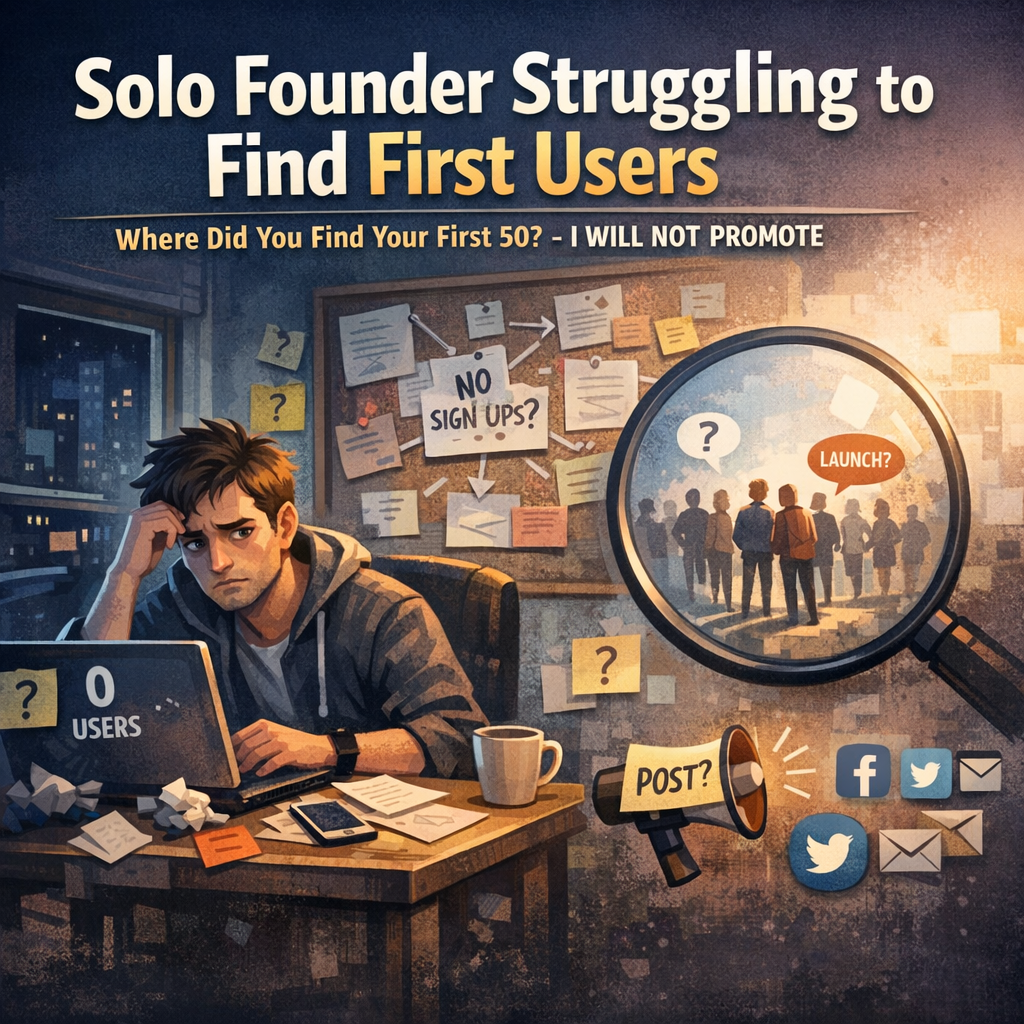
The Cold Start Reality and What Actually Matters Early On
Every founder hits this moment eventually: you’ve built something thoughtful, maybe even genuinely useful, but it feels like you’re shouting into the void. No audience, no distribution, no clear path forward—just a growing sense that building more won’t solve the problem.
If that sounds familiar, you’re not alone. The early-stage “cold start” is one of the most misunderstood phases in building a product. It’s not about scaling tactics or growth hacks yet—it’s about finding your first 20–50 people who truly care.
This article breaks down what actually works at this stage, based on real founder experiences—not theory. You’ll learn where early users really come from, how to approach them, and how to turn those first conversations into traction.
Early users are not just smaller in number—they’re fundamentally different in behavior and expectations. They are closer to collaborators than customers.
At this stage, you’re not optimizing conversion funnels or ad spend. You’re searching for signal: Who cares enough about this problem to engage, respond, and come back?
One of the most important mindset shifts is this: volume doesn’t matter yet—retention does. A spike of 100 signups that disappear in a week is far less valuable than 10 users who stick around and give feedback.
Founders often make the mistake of chasing visibility too early. But before distribution scales, it needs to be precise. The goal isn’t reach—it’s resonance.
(Suggested visual: A simple funnel diagram showing the difference between early-stage validation vs. growth-stage acquisition.)
Where Early Users Come From in Practice
Despite the endless advice online, early users rarely come from scalable channels. They come from proximity—places where your target users already spend time.
Real examples from founders show consistent patterns:
Communities are the starting point. Reddit threads, niche Facebook groups, Slack communities, Discord servers—these are environments where people already talk about their problems. When someone complains about an issue your product solves, that’s not noise—that’s an invitation.
Cold outreach works better than most expect, especially when it’s contextual. Messaging someone who is actively expressing frustration (“I can’t keep up with my inbox”) is far more effective than generic promotion.
Interestingly, lower-friction entry points outperform full product onboarding early on. A simple waitlist often converts better than asking someone to create an account and explore a half-finished product. At this stage, curiosity is easier to earn than commitment.
And then there’s the least scalable but most valuable method: one-on-one conversations. Founders consistently report that their first 20 users came from roughly 20 conversations. These aren’t just acquisition tactics—they’re product discovery engines.
(Suggested visual: A flow showing “Community → Conversation → Signup → Feedback loop.”)
The Power of Narrowing Your Audience
If there’s one lever that consistently unlocks early traction, it’s specificity.
Broad ideas feel exciting, but they rarely convert. When your product tries to serve “creators,” “learners,” or “professionals,” the message becomes diluted. People don’t recognize themselves in it.
Instead, traction often appears when the audience becomes almost uncomfortably narrow.
For example, instead of targeting “people who want to learn online,” you might focus on “early-stage founders trying to learn practical growth tactics from credible creators.”
This level of clarity does two things:
First, it sharpens your messaging. If someone can understand the problem and the benefit in under ten seconds, you’re on the right track.
Second, it improves retention. The more specific the problem, the more likely users are to stick around if you solve it.
Many founders only discover this after trying broad outreach and seeing weak results. The signal improves dramatically when the audience is constrained.
(Suggested visual: Before/after messaging examples showing vague vs. specific positioning.)
A Practical Path to Your First 20–50 Users
While there’s no universal formula, a few patterns show up repeatedly in successful early-stage efforts. Think of this less as a rigid system and more as a practical starting point.
Start with one persona and one urgent use case. Avoid the temptation to serve multiple audiences at once. Clarity beats coverage.
Then, manually reach out to people who fit that profile. Around 20–30 targeted messages is often enough to start seeing patterns. The key is to lead with the problem, not the product.
Offer something in return for their time. A short onboarding call framed as “I’m trying to understand this problem better” works surprisingly well. People are more willing to help than you might expect—especially when approached honestly.
Track everything. Even a simple spreadsheet with “source → signup → active after 2 weeks” can reveal which channels are worth continuing.
Finally, double down only on what retains users. Early on, it’s easy to get distracted by what brings traffic. But the real signal is who stays.
This approach does two things at once: it gets you users and improves your product. Each conversation tightens your understanding of the problem, which improves your positioning, which then improves conversion.
It’s a loop—not a funnel.
Turning Early Traction into Clear Direction
Lower the barrier to entry. If your product requires effort to understand, start with a waitlist or a simple landing page that communicates value clearly.
Talk to users before and after they sign up. Pre-signup conversations reveal expectations; post-signup conversations reveal reality.
Measure retention early. A user who comes back after two weeks is far more valuable than one who signs up instantly and disappears.
If people aren’t signing up, your positioning is likely too broad or unclear. If they are signing up but not staying, your product or onboarding needs work.
Don’t spread yourself across too many channels. Most early traction comes from one repeatable source, not five mediocre ones.
And most importantly, don’t confuse activity with progress. Building, tweaking, and experimenting can feel productive—but real progress at this stage is measured in engaged users, not features shipped.
(Suggested formatting: This section could be turned into a checklist or quick-reference guide for readability.)
The early stage of building a product isn’t about finding a scalable growth engine—it’s about finding a small group of people who genuinely care.
Your first 20–50 users won’t come from perfect marketing strategies. They’ll come from conversations, communities, and deliberate focus.
If you feel stuck, it’s often not because you haven’t done enough—it’s because the signal is still buried under too much breadth. Narrow the audience. Simplify the message. Talk to people directly.
Once you find even a small pocket of users who stick, everything becomes clearer. Distribution gets easier, messaging sharpens, and the product starts to evolve in the right direction.
The goal isn’t to go viral. It’s to get specific.
References and Further Reading
For deeper insights into early-stage traction and user acquisition, consider exploring:
- “The Mom Test” by Rob Fitzpatrick (on user conversations and validation)
- “Traction” by Gabriel Weinberg and Justin Mares (frameworks for finding growth channels)
- First Round Review (case studies on early-stage startup growth)
- Indie Hackers (real founder stories on acquiring first users)
- Y Combinator’s Startup School content (practical advice on early traction and product-market fit)
These resources reinforce a consistent theme: early growth isn’t about scale—it’s about learning what actually works before scaling it.