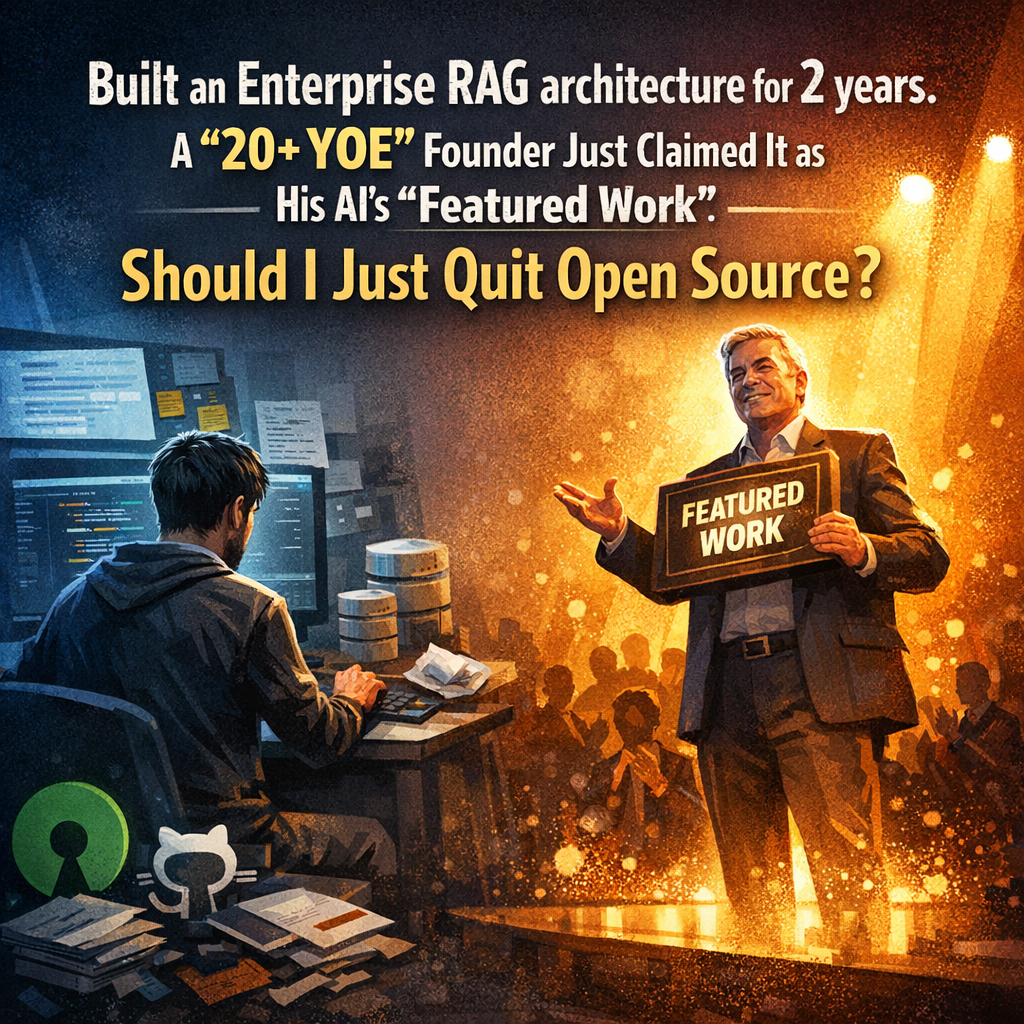
The Tension of Building in Public
It’s one of the most painful moments a builder can experience: you spend years crafting something complex, thoughtful, and genuinely innovative—only to see someone else publicly claim it as their own. In the age of open source and AI-driven development, this scenario is becoming more common, and it raises a difficult question: how do you build in public without becoming someone else’s free R&D department?
This article explores the real tension between open source and SaaS through a founder’s dilemma—what happens when your work is copied, repackaged, and used for someone else’s gain. More importantly, it breaks down what actually protects your work, whether shutting down open source is the right move, and how to transition toward a sustainable business model without losing your edge.
The Emotional Reality of Building in Public
Open source is often framed as a noble, community-driven effort—but it’s also deeply personal. When you publish your work, you’re not just sharing code; you’re sharing judgment, architecture decisions, and countless hours of iteration.
So when someone copies that work and presents it as their own, the reaction is rarely neutral. It feels like theft, even when the license technically allows reuse.
In this case, the builder responded by archiving all repositories and stepping away from open source entirely. That reaction is understandable—but it introduces a critical trade-off: the people most affected by shutting down your project are not the bad actors, but the legitimate users who would have become your advocates, contributors, and eventually, customers.
This is the paradox of open source: once something is public, bad actors can copy it—but so can everyone else who would help your project grow.
(Suggested visual: a simple diagram showing “Open Source Exposure” branching into both “Community Growth” and “Risk of Misuse.”)
What Actually Protects Your Work
Many founders assume that licenses like AGPLv3 are strong enough to prevent misuse. Legally, AGPL is one of the strictest licenses available—it requires derivative works, even over a network, to remain open.
But in practice, enforcement is difficult and expensive. Most violators rely on one simple assumption: you won’t pursue legal action.
So what actually protects you?
The answer is less legal and more operational.
In complex systems like enterprise RAG architectures, the real moat isn’t the code—it’s everything around it:
- Deployment knowledge and infrastructure setup
- Tuning parameters and edge-case handling
- Production hardening and reliability engineering
- Customer-specific adaptations and workflows
This is often called “information asymmetry.” You know things about your system that aren’t written down anywhere. That knowledge compounds over time and is extremely difficult to replicate.
A competitor can copy your repository—but they can’t easily copy your experience debugging it at 3 a.m. in production.
(Suggested visual: layered stack showing “Code” at the bottom and “Operational Expertise” at the top as the real moat.)
Why Shutting Down Open Source Can Backfire
Archiving your repositories might feel like reclaiming control—but strategically, it often does the opposite.
The copycat already has your code. They’re unaffected.
The people who lose access are:
- Future users who might have adopted your system
- Developers who could have contributed improvements
- Potential customers who discovered you through open source
In other words, you cut off your growth engine while leaving the bad actor untouched.
This is why many experienced founders advise against fully abandoning open source after an incident like this. Instead, they recommend evolving your model.
Historically, companies like MongoDB, Elastic, and HashiCorp faced similar challenges. Their solution wasn’t to shut down—it was to restructure what they offered.
The Open Source to SaaS Playbook
If your project is gaining attention—and even being copied—that’s not just a problem. It’s also validation that what you built is valuable.
The key is to separate what should be open from what should be monetized.
Here’s a proven approach:
1. Maintain a Strong Community Edition
Keep a version of your product open source that is genuinely useful. Avoid crippling it to the point where it becomes irrelevant. A healthy community edition builds trust, adoption, and distribution.
2. Gate Enterprise Features Behind a Paid License
Organizations don’t pay for code—they pay for confidence. That includes:
- SSO and access control
- Audit logs and compliance features
- Multi-tenant architecture
- Performance guarantees and SLAs
- Managed hosting or support
These features are difficult to replicate and highly valuable in enterprise environments.
3. Consider a License Shift
If you haven’t already, moving to AGPLv3 or a source-available license can increase friction for copycats. Some companies go further with dual licensing models—open for the community, commercial for businesses.
4. Build Faster Than Copycats Can Keep Up
The original creator has one massive advantage: velocity. You understand the system at a level others don’t.
Copycats are always reacting. You’re leading.
(Suggested visual: timeline comparing “Original Builder” vs “Copycat” showing lag in innovation.)
Turning the Situation Into Leverage
There’s also a less obvious opportunity in situations like this: visibility.
If someone publicly misrepresents your work, and you have evidence, calling it out (professionally and factually) can work in your favor.
Open source communities care deeply about attribution. When violations are exposed:
- The original creator often gains credibility
- The violator loses trust with users and investors
- The broader community rallies around the authentic project
This doesn’t mean starting drama—but it does mean you don’t have to stay silent if your work is misused.
If you’re facing a similar situation, here are some grounded steps you can take:
- Don’t make permanent decisions in the heat of frustration. Archive if needed—but revisit with a clear head.
- Separate emotional response from strategic direction. They’re not the same.
- Document your architecture and evolution publicly to establish authorship.
- Focus on distribution and user adoption—this is your strongest long-term defense.
- Start monetizing earlier than feels comfortable. Perfection is not a prerequisite for value.
- Keep your core open if it drives growth, but move critical business features behind a paywall.
- Invest in branding and narrative. People follow creators, not just codebases.
(Suggested formatting: this section could be presented as a clean bullet list or checklist for readability.)
The instinct to shut everything down after being copied is human—but it’s rarely the move that maximizes your long-term success.
Open source is not just about sharing code; it’s about building momentum, reputation, and trust. Those are much harder to steal than a repository.
The builders who succeed in this space don’t avoid being copied—they design systems where copying doesn’t matter.
Your real advantage is your understanding, your speed, and your relationship with users. That’s what turns a project into a company.
If anything, being copied is a signal: you built something worth taking.
The next step is making sure you’re the one who benefits from it.
References and Further Reading
- “The Business of Open Source” by OpenCore Ventures
- MongoDB, Elastic, and Redis licensing history (case studies)
- GNU AGPLv3 License documentation (gnu.org)
- “Open Core Model” explained by various SaaS founders and VCs
- Articles on information asymmetry in startups (e.g., Andreessen Horowitz blog)
Exploring these resources can help you better understand how successful companies have navigated the same challenges—and how you can apply those lessons to your own path forward.