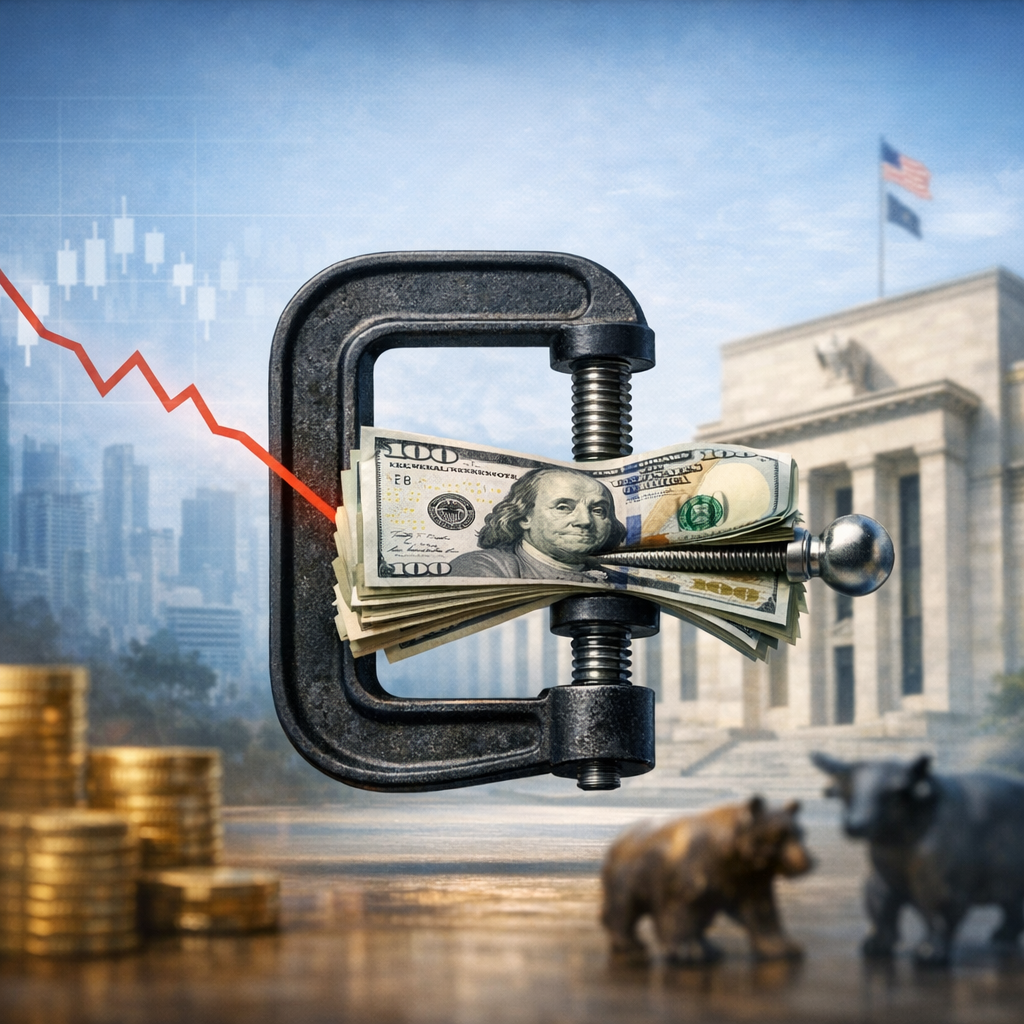
The Fed’s Shift: Ending QT and What It Signals
The Federal Reserve’s recent announcement that it will end quantitative tightening (QT) by December 1st, 2025 has sparked a wave of excitement—and confusion—across financial markets. To some, it sounds like a green light for cheaper money, rising asset prices, and renewed economic momentum. To others, it’s a warning sign that something beneath the surface may already be breaking. So what does this decision actually mean, and how should we interpret it in a world increasingly shaped by rapid AI-driven growth?
In this article, we’ll break down what ending QT really does, why the Fed may be making this move now, how it affects inflation and markets, and whether it adds fuel to concerns about a potential AI-driven asset bubble.
Understanding Quantitative Tightening and Its Reversal
To understand the significance of this announcement, we need to start with the basics. Quantitative tightening is the process by which the Federal Reserve shrinks its balance sheet, primarily by allowing bonds it holds to mature without reinvesting the proceeds. This effectively removes liquidity from the financial system.
When QT ends, that draining effect stops. Importantly, it doesn’t mean the Fed is actively injecting new money (as it would with quantitative easing), but it does mean the system is no longer losing liquidity at the same pace.
This distinction is critical. While headlines may suggest a “pivot” toward easier policy, the reality is more nuanced. Ending QT is often less about stimulating growth and more about preventing unintended stress in financial markets.
A useful way to visualize this is through a chart showing the Fed’s balance sheet over time. An infographic here could highlight the expansion during QE periods and the gradual decline during QT, with a clear marker indicating the planned stop date.
Why the Fed May Be Acting Defensively
At first glance, stopping QT might look like a proactive move to support growth. However, a closer look suggests it may be more defensive than optimistic.
During QT, liquidity is steadily drained from the system. Banks often step in to buy government debt, which reduces their reserves held at the Fed. At the same time, if the U.S. Treasury is issuing more debt or holding onto cash—such as during periods of fiscal uncertainty—this can further pull liquidity out of private markets.
These overlapping forces can create stress in short-term funding markets, where banks and institutions rely on stable liquidity to operate smoothly. A historical example is the 2019 repo market disruption, when a sudden shortage of liquidity caused borrowing rates to spike unexpectedly.
Ending QT early may signal that policymakers are trying to avoid a repeat of such an event. In other words, rather than signaling strength, it could indicate that the financial system is closer to its “liquidity floor” than expected.
A timeline graphic here could help illustrate key events like the 2019 repo spike, pandemic-era QE, and the current QT phase.
Liquidity, Inflation, and Market Trade-Offs
More liquidity in the system tends to lower borrowing costs and encourage investment. Companies find it easier to finance expansion, and investors become more willing to take risks. This can boost stock markets, credit markets, and even speculative sectors.
However, there’s a trade-off. Increased liquidity can also fuel inflation, especially if it drives up demand faster than supply can respond. We’ve already seen how excess liquidity during the pandemic contributed to rising prices across housing, vehicles, and consumer goods.
For everyday consumers, the benefits of lower interest rates are not always straightforward. While monthly payments on loans may decrease slightly, those gains can be offset if home prices, car prices, and other essential costs remain elevated—or continue rising.
This dynamic has been particularly visible in housing and auto markets. For example, even as financing conditions improve, affordability remains strained if asset prices stay high. In some cases, underlying issues such as declining construction quality or rising loan delinquencies add further pressure.
A side-by-side chart comparing wage growth, inflation, and asset price increases would be especially useful here to illustrate the imbalance.
AI Hype and the Risk of Asset Bubbles
The timing of this decision is especially interesting given the surge in AI-related investments. Over the past few years, capital has poured into companies associated with artificial intelligence, driving valuations higher and creating parallels to past speculative cycles.
When liquidity conditions ease—or even stop tightening—risk appetite tends to increase. Investors may be more willing to fund ambitious projects, bid up growth stocks, and overlook profitability concerns in favor of long-term narratives.
This doesn’t necessarily mean there is a bubble, but it does create conditions where one can form more easily. History offers several examples, from the dot-com era to the post-2008 tech boom, where abundant liquidity amplified enthusiasm into overvaluation.
There’s also a behavioral element. Many retail investors interpret policy shifts as simple signals: “easing equals buy.” This can lead to crowded trades and speculative behavior, especially in sectors with strong narratives like AI.
In that sense, ending QT could unintentionally reinforce momentum in already overheated areas of the market, even if that’s not the Fed’s intention.
Navigating the Environment with Caution and Perspective
Rather than viewing the end of QT as purely positive or negative, it’s more helpful to see it as a balancing act. The Fed is trying to maintain financial stability without reigniting inflation or encouraging excessive risk-taking.
Here are a few practical ways to interpret and respond to this environment:
- Focus on fundamentals. Companies with strong earnings and sustainable business models are better positioned than those relying solely on hype.
- Watch liquidity indicators. Metrics like bank reserves, repo rates, and credit spreads can provide early signals of stress or stability.
- Be cautious with leverage. Easier financial conditions can encourage borrowing, but that can quickly become risky if conditions change.
- Diversify exposure. Avoid concentrating too heavily in one high-growth sector, even one as promising as AI.
- Keep a long-term perspective. Policy shifts can drive short-term market movements, but long-term outcomes depend on economic fundamentals.
A checklist-style infographic could work well here to summarize these principles for quick reference.
The Fed’s decision to end quantitative tightening by December 2025 is not a simple pivot toward easy money—it’s a nuanced move aimed at preserving financial stability. While it may support liquidity and risk appetite in the short term, it also raises important questions about inflation, asset prices, and the sustainability of current market trends.
In the context of growing excitement around AI, this shift could amplify both opportunities and risks. More liquidity can fuel innovation and investment, but it can also inflate valuations beyond what fundamentals justify.
Ultimately, the key takeaway is that monetary policy doesn’t operate in isolation. Its effects ripple through markets, behavior, and expectations. Understanding those dynamics is essential for navigating what comes next.
As always, staying informed—and maintaining a healthy level of skepticism—may be the most valuable investment strategy of all.
References and Further Reading
- Federal Reserve official statements and balance sheet reports
- Barron’s coverage of the Fed announcement: https://www.barrons.com/livecoverage/fed-meeting-october-interest-rate-announcement/card/the-fed-is-ending-quantitative-tightening-Ek5hOC6Z1ys8JCFLomQB
- Federal Reserve Bank of New York resources on repo markets
- IMF and World Bank reports on global liquidity and inflation trends
- Historical analysis of the 2019 repo market disruption